Data · 6 min
Data Governance with Microsoft Purview
How Microsoft Purview's Unified Catalog turns a sprawling data estate into governed, discoverable data products, with governance domains, data quality, and self-service access.

Amrutha Satishkumar
May 15, 2026

The problem is not that you lack data. It is that no one can find or trust it
Most enterprises do not have a data shortage. They have the opposite. Tables, files, reports, and pipelines pile up across clouds and teams until the estate becomes a warehouse no one has a map for. People cannot find the data they need, and when they do find it, they are not sure they can trust it or whether they are even allowed to use it. Governance often gets bolted on late as a gatekeeping function, which makes it feel like friction rather than value.
Microsoft Purview approaches this differently. Its Unified Catalog treats governance not as a lock on the door, but as the thing that makes your data findable, understandable, and safe to use at scale. Here is how it works and why the model matters.
From cataloging data to governing it
Classic data catalogs answered one question: what data do we have? Purview still does that underneath, keeping an inventory of your assets, their metadata, and their lineage so you can see the shape of the estate. The Unified Catalog adds the harder question on top: how do we govern this data as it grows, without creating a central bottleneck?
The answer is a federated governance model. You set standards for quality, safety, and access in one place, then hand the day to day ownership to the teams closest to the data. Central rigor, local flexibility. That balance is the whole point, because a single team cannot realistically govern every dataset in a large organization, and a free for all governs nothing.
The building blocks
The Unified Catalog organizes governance around a few connected concepts.
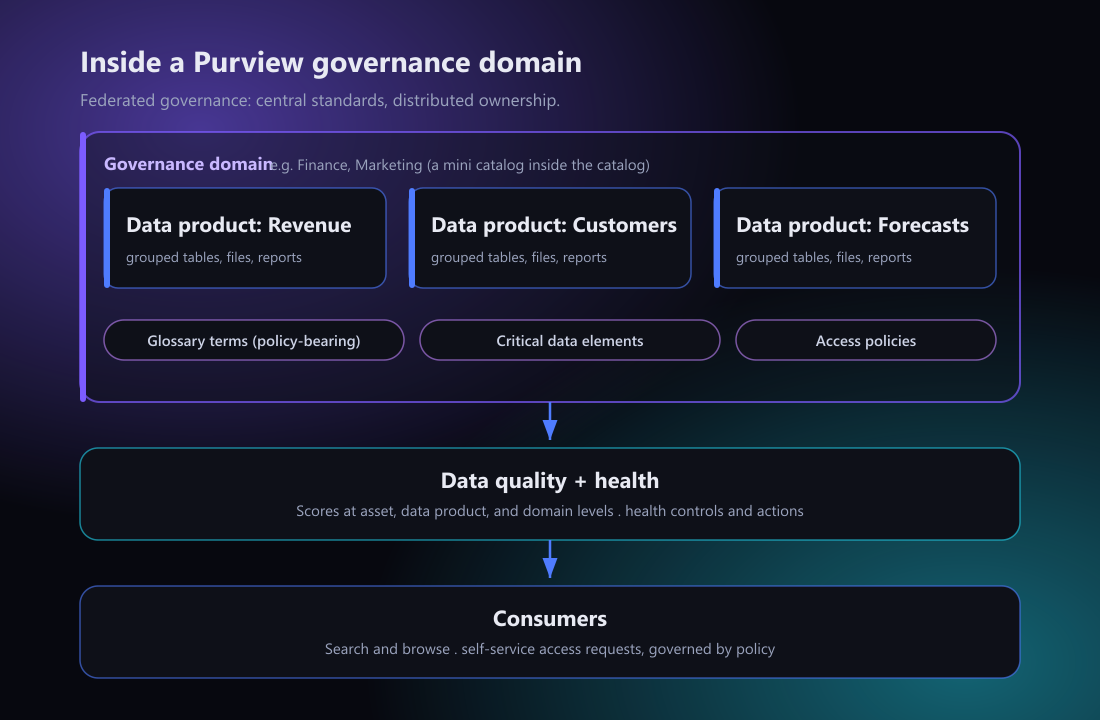
- Governance domains. A governance domain is a business-shaped boundary over your estate, like Finance or Marketing. Think of it as a mini catalog inside the catalog. Instead of one overwhelming list, people browse the domain that matches their work, and ownership is distributed to that part of the business.
- Data products. A data product groups related assets, tables, files, and Power BI reports, into one discoverable package with business context. You no longer chase access to fifteen separate tables to build one model. One person curates the product, and everyone else reuses that work.
- Glossary terms. In the Unified Catalog, glossary terms are not just static definitions. They are active objects that carry policy. A term applied to a data product trickles down to the underlying assets and secures them with the policies attached to that term, so your business vocabulary becomes a governance lever.
- Critical data elements. These logically group a key piece of information wherever it lives, for example mapping “CustID” in one table and “CID” in another into a single “Customer ID” element. You attach quality rules and access policies to that element and apply them consistently across the estate.
Making data trustworthy, not just findable
Discoverability is only half the job. If people cannot trust the data, a tidy catalog just helps them find the wrong numbers faster. The Unified Catalog builds trust in with two related capabilities.
- Data quality. You set quality rules at the governance domain, data product, and individual asset levels, and those rules produce quality scores at each level. That gives you a clear read on where the estate is healthy and where it needs work, rather than a vague sense that “the data is probably fine.”
- Data health. Health controls score your governance practices against standards, and health actions turn that score into a concrete to do list. Ready made reports show the state of the estate at a glance, and objectives and key results tie data health back to real business goals so governance is measured by outcomes, not activity.
Access without the bottleneck
The fastest way to kill a governance program is to make getting data slow. The Unified Catalog leans on self-service access policies instead. A consumer finds a data product, requests access with a single request from inside the catalog, and the request is evaluated against the compliance and right-use standards attached to that product. People get what they need quickly, and the guardrails travel with the data rather than living in someone’s head or a separate ticketing queue.
Why this matters more in the age of AI
AI raises the stakes on all of this. Agents and copilots are only as trustworthy as the data they draw on, and they will happily surface whatever they can reach, governed or not. A well run catalog means an AI system is grounded in data that is discoverable, quality scored, and permission aware, so sensitivity labels and access rules are honored automatically rather than approximated in application code. Governance stops being the thing that slows AI down and becomes the thing that makes it safe to ship.
Where this is heading
The shift Purview represents is that data governance is moving from defense to enablement. For years it was a compliance chore, a way to avoid getting into trouble. The Unified Catalog reframes it as the layer that reunites a business with the data that fuels it: organized by domain, packaged as products, scored for quality, and available through self-service. As data estates keep growing and AI keeps reaching deeper into them, the organizations that treat governance as an accelerator, not a brake, are the ones whose data will actually be usable.
If you run a data estate today, the question is no longer only “what data do we have?” It is “can the right person, or the right agent, find it, trust it, and use it safely?”
Sources
This post is based on Microsoft’s public documentation:
- Learn about Microsoft Purview Unified Catalog (Microsoft Learn, governance domains, data products, quality, and health)
- Get started with data governance (Microsoft Learn, setting up the Unified Catalog)
Amrutha Satishkumar
Data & AI Solution Engineer at Microsoft