Data · 4 min
The Foundation Beneath Every Power BI Report
How the Power BI semantic model, built on a clean medallion architecture, turns raw data into trusted, consistent metrics, and why it matters even more with AI.

Amrutha Satishkumar
February 20, 2026

For a long time, many teams treated Power BI as a visualization tool.
Load the data.
Create a few measures.
Build the report.
Ship it.
If the charts looked right and stakeholders were satisfied, the job felt done.
But over time, it starts to break and doesn’t sound reliable.
Different reports show slightly different numbers.
Teams define the same metric in different ways.
Security rules get layered inconsistently.
New developers struggle to understand how things connect.
At that point, it becomes clear:
“The report was never the real product. The model was.”
In Power BI, the semantic model is not just a technical layer. It is where business meaning is defined and enforced.
What the Semantic Model Actually Does
The semantic model defines relationships between tables, measures, KPIs, hierarchies, and row-level security rules. It translates raw data into structured business logic.
When someone sees revenue, margin, churn, or growth on a dashboard, they are not seeing raw database columns. They are seeing logic defined in the semantic layer.
Visuals consume logic. They do not create it.
If that logic is inconsistent, every visual built on top of it inherits that inconsistency.
Why the Data Architecture Beneath It Matters
A clean semantic model does not exist in isolation. It depends on clean data architecture upstream.
This is where a medallion architecture becomes critical.
In a medallion setup:
-
Bronze contains raw ingested data
-
Silver contains cleaned and standardized data
-
Gold contains curated, business-ready data
The semantic model should ideally sit on top of the Gold layer.
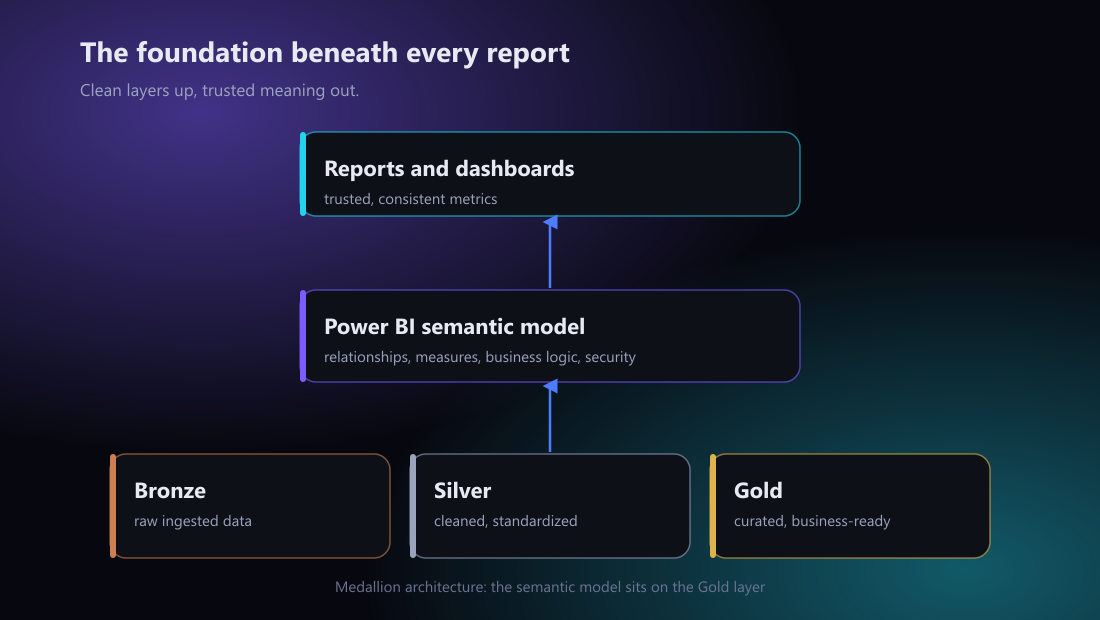
If Power BI connects directly to raw or partially transformed data, the semantic model becomes overloaded. Developers start embedding transformation logic in DAX. Business definitions creep into report files. The boundary between storage and meaning becomes blurred.
If your Gold layer is unclear, your semantic model will compensate. And compensation leads to complexity.
When Bronze, Silver, and Gold layers are clearly defined, the semantic model can focus on what it should: relationships, measures, and business meaning.
When the Model Is Clean
A clean semantic model reflects business concepts rather than ingestion structure.
Relationships are explicit and intentional. Measures are defined once and reused. Naming conventions are consistent. Dimensions follow a star schema pattern.
In this environment:
-
Reports align across teams
-
Metrics are trusted
-
Security rules behave predictably
-
New use cases can be added without rewriting logic
The model becomes stable enough to support growth.
When the Model Is Messy
If relationships are ambiguous, measures are duplicated across reports, and raw transformation logic leaks into the model, confusion builds quietly.
One team calculates churn one way.
Another team defines active users differently.
Someone embeds logic inside a visual to “fix” a number.
Over time, stakeholders begin to question the system.
Inconsistent numbers are rarely a visualization problem. They are a modeling problem.
And often, the modeling problem began upstream.
Why This Matters Even More Now
As analytics tools become more self-service and AI-assisted, the semantic layer becomes even more important. It is the same reason agent-ready data starts with a clean model, not a clever prompt.
Conversational interfaces, automated insights, and AI-generated reports all depend on structured business definitions. They assume that revenue means one thing, churn means one thing, and customer segments are clearly defined.
If the model is fragmented, automation simply accelerates inconsistency.
If the model is clean, automation scales clarity.
AI can accelerate insight, but only if the definitions underneath are stable.
That clean model is also the foundation an ontology and data agents build on. Get the model right, and everything downstream, from dashboards to agents, inherits that clarity.
What This Really Comes Down To
Building dashboards is visible work. Modeling is not.
But modeling determines whether your system can survive scale, new teams, new requirements, and new tools.
A clean medallion architecture ensures that raw data is separated from curated business data. A clean semantic model ensures that curated business data is translated into consistent meaning.
When both layers are disciplined, Power BI becomes more than a reporting tool. It becomes a structured decision system.
And when both layers are neglected, no amount of visual polish can compensate.
Amrutha Satishkumar
Data & AI Solution Engineer at Microsoft