Data · 4 min
Fabric Data Agents and Claude
How Fabric Data Agents let a model like Claude answer questions over enterprise data in natural language, while the semantic model keeps every answer governed and consistent.

Amrutha Satishkumar
February 20, 2026

For years, we have treated AI and data platforms as two separate conversations.
AI was the exciting layer. It generated text, summarized documents, answered questions. Data platforms were the structured layer. They stored records, enforced rules, and powered dashboards.
When we tried to connect the two, the most common pattern was simple: let a language model generate SQL over a database. The demo looked impressive. Ask a question, get a query, see an answer.
But underneath, it was often fragile.
“A model can generate a query. That doesn’t mean it understands the business.”
Database schemas reflect storage design, not business meaning. Metric definitions are often embedded in transformations. Security policies can be layered in ways that are not visible at query time. A model might produce technically valid SQL while still misrepresenting how revenue or churn is defined.
That is where the integration between Microsoft Fabric Data Agents and models like Claude changes the pattern.
It does not simply attach AI to data.
It embeds reasoning inside a governed system.
Where Fabric Data Agents Change the Pattern
Fabric Data Agents allow users to ask questions about enterprise data in natural language. That part is straightforward.
What matters more is where the reasoning happens.
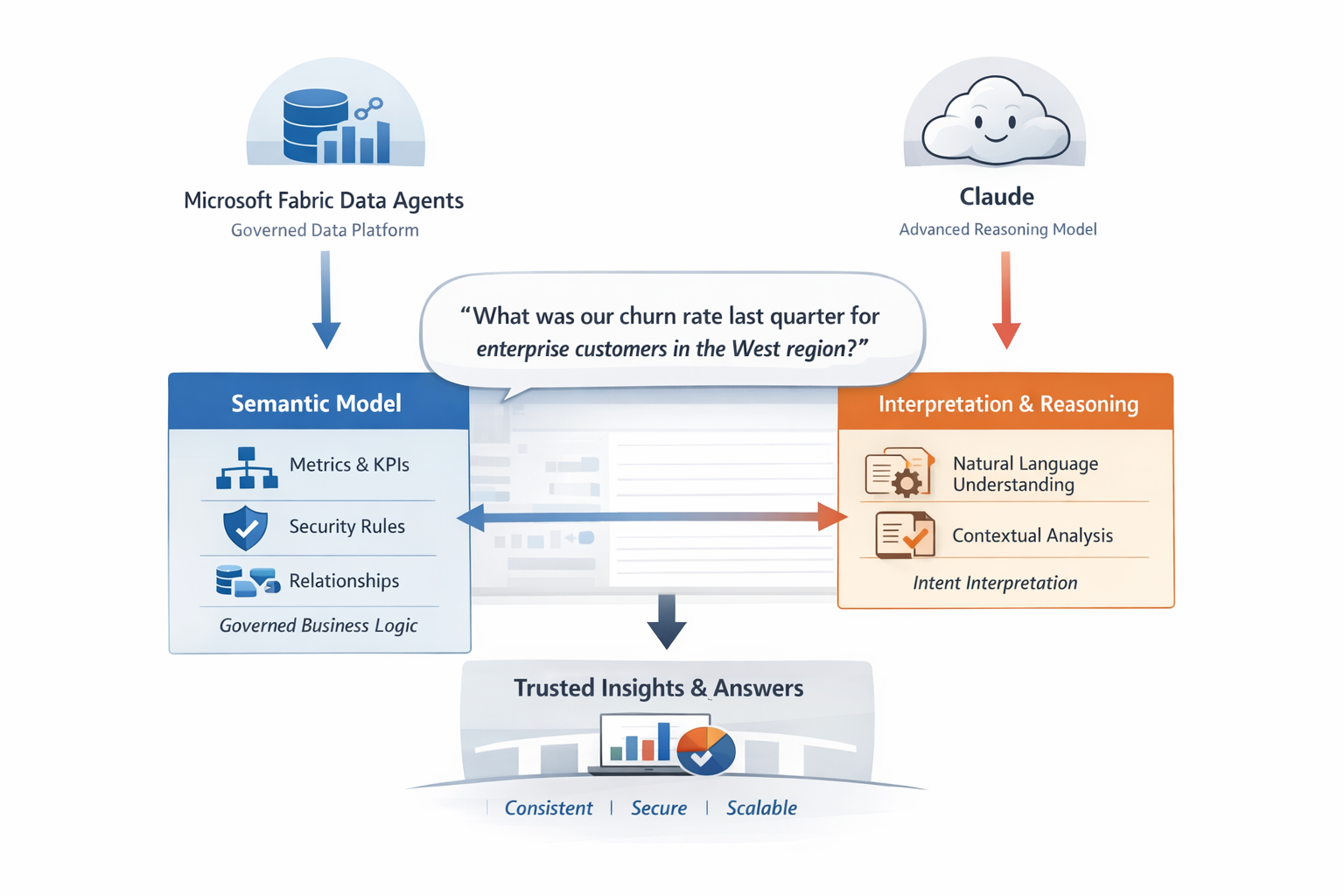
Instead of generating queries directly against raw lakehouse tables, the agent operates over the semantic model. This semantic layer already contains defined relationships, approved measures, curated KPIs, and enforced row-level security.
“The agent is not querying tables. It is querying meaning.”
When someone asks, “What was our churn rate last quarter for enterprise customers in the West region?” the answer is not reconstructed from raw columns. It relies on the churn definition already modeled, the customer segmentation already defined, and the security rules already applied.
The logic exists before the question is asked. The agent simply navigates it.
That architectural boundary makes the difference between a demo and a dependable system.
Where Claude Fits In
Claude’s strength lies in interpreting intent and handling ambiguity. It can follow multi-step reasoning, maintain context across a conversation, and translate loosely framed questions into structured analytical requests.
Within Fabric Data Agents, Claude plays the role of interpreter and reasoning engine. It helps map natural language into analytical intent. It can refine follow-up questions and explain results clearly.
But it does not redefine business metrics. It does not change how revenue is calculated. It does not override churn definitions or bypass governance.
“Claude understands the question. The semantic model defines the answer.”
The semantic layer remains the source of business truth. Fabric enforces relationships, metric definitions, and security policies. Claude reasons within those established boundaries.
That separation of responsibilities keeps the system reliable even as the interface becomes conversational.
Why the Semantic Layer Becomes Central
Earlier approaches to conversational analytics often allowed models to generate SQL directly over database schemas. While technically possible, that approach depends heavily on how well the model interprets physical structure.
Schemas describe tables and columns. They do not necessarily reflect how the business defines performance, risk, or growth.
Without a semantic boundary, a model may reconstruct business logic differently each time. That leads to inconsistency, especially when multiple teams depend on shared metrics.
By routing reasoning through the semantic layer, Fabric ensures that measures are defined once and reused consistently. Relationships between entities are preserved. Row level security is inherited automatically.
“Consistency does not come from the model. It comes from the model of the business.”
Claude enhances reasoning, but it does not replace the modeling discipline underneath.
What This Means for Data Teams
This integration places greater importance on semantic modeling.
If definitions are inconsistent, the conversational interface will surface that inconsistency quickly. If relationships are unclear, answers may feel confusing. If governance is weak, gaps will become visible.
Language models amplify whatever foundation exists.
“AI does not fix structural problems. It exposes them.”
In this architecture, the semantic model becomes the intelligence layer. It defines what the system is allowed to mean. Claude helps interpret user intent, but business logic remains encoded in structured definitions.
For data teams, this makes semantic design not just a reporting concern, but a prerequisite for reliable AI interaction.
What This Enables
Fabric Data Agents integrated with Claude allow business users to explore governed data conversationally. They can ask follow-up questions, request clarifications, and receive explanations without writing SQL or navigating complex dashboards.
At the same time, the answers remain aligned with defined business logic. Security policies are respected. Metric definitions are consistent.
AI is not operating outside the data platform. It is functioning within the same boundaries that enforce trust.
“When reasoning operates inside governance, trust scales with intelligence.”
That alignment is what makes this architecture usable in real enterprise environments.
It is not just about asking better questions.
It is about ensuring the answers remain consistent, secure, and meaningful.
Amrutha Satishkumar
Data & AI Solution Engineer at Microsoft