AI · 5 min
Fabric IQ, Fabric Data Agents, Azure AI Foundry, and MCP: How They Work Together
How Fabric IQ, Fabric Data Agents, Azure AI Foundry, and MCP fit together in enterprise AI architectures, and when the Model Context Protocol is actually required.

Amrutha Satishkumar
February 24, 2026
Introduction
Enterprise AI systems are no longer built from a single product. They are layered architectures composed of four distinct responsibilities.
1. A reasoning engine
2. A governed data layer
3. A tool invocation interface
4. An execution environment
In Microsoft-centric architectures, these roles are typically fulfilled by Fabric IQ, Fabric Data Agents inside Microsoft Fabric, Azure AI Foundry, and the Model Context Protocol known as MCP.
Understanding how these components work together requires separating their responsibilities clearly. Most architectural confusion happens when reasoning, governance, and execution are mixed together.
This article explains how Fabric IQ, Fabric Data Agents, Azure AI Foundry, and MCP fit together, and when MCP is actually needed.
Fabric IQ: the business context layer inside Microsoft Fabric
Fabric IQ is the context layer inside Microsoft Fabric. It is not a chat box. It is the shared business meaning that agents reason over, delivered through two things: a semantic model and an ontology (in preview) sitting over your data in OneLake.
In practice, Fabric IQ is what tells an agent that “revenue” and “active customer” mean something specific, how entities like Order, Product, and Store relate, and which business rules apply. It turns raw tables into concepts an agent can trust.
Because Fabric IQ lives entirely inside the governed Fabric environment, it has native access to semantic models, lakehouses, warehouses, Power BI models, and governance policies. There is no external boundary.
If your AI interaction stays fully inside Fabric, grounded on Fabric IQ, MCP is not required, because no cross-system tool invocation is happening.
Fabric Data Agents Governed Analytical Execution
Fabric Data Agents are analytical agents that execute against the Fabric semantic model.
They interpret analytical questions, operate over curated business models, enforce row-level security, and respect defined measures and relationships.
This matters because the semantic model defines KPI formulas, metric calculations, hierarchies, and security boundaries.
Fabric Data Agents do not dynamically redefine business logic. They execute within established business truth.
This ensures analytical consistency across users and workloads.
Azure AI Foundry External Reasoning and Orchestration
Azure AI Foundry provides model hosting for large language models and an Agent Service for multi-step orchestration.
It is typically used when enterprise agents must coordinate across multiple systems such as CRM, ERP, operational databases, and Fabric together.
When reasoning moves into Foundry it introduces a system boundary.
The reasoning layer and the governed execution layer are now separate.
This separation is where MCP becomes relevant.
The Model Context Protocol Structured Tool Invocation Across Boundaries
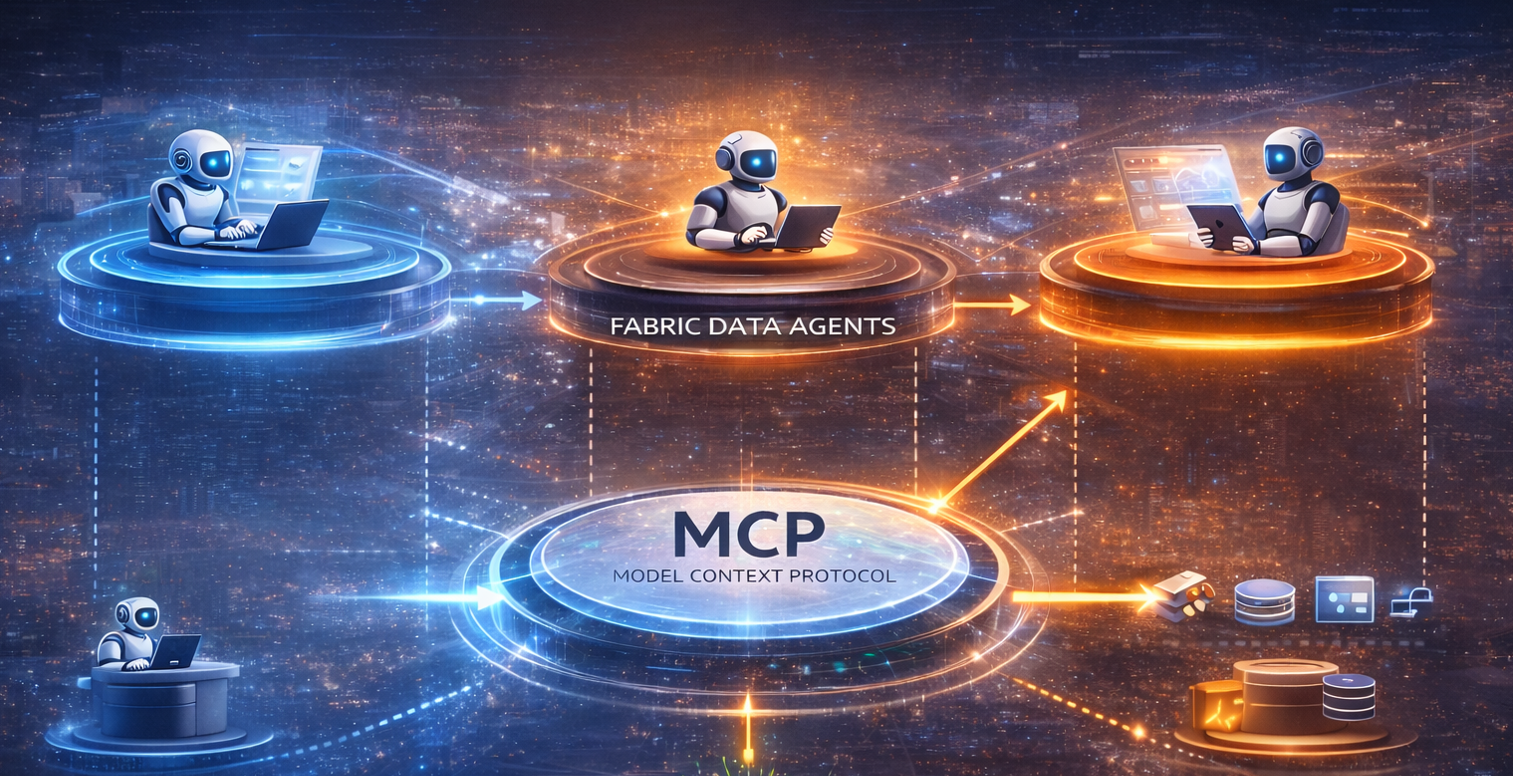
The Model Context Protocol standardizes how AI agents call tools across-system boundaries.
It defines tool schemas, structured parameter validation, invocation formats, output contracts, and discoverability of capabilities.
When a Foundry-hosted agent needs to call Fabric Data Agents, MCP provides a structured contract for that interaction.
Without MCP integration it often relies on custom REST APIs, manual argument construction, hard-coded client libraries, and inconsistent logging.
MCP makes cross-system invocation deterministic, inspectable, and auditable.
The important distinction is this.
MCP is needed only when reasoning and execution live in different systems.
How They All Tie Together
The relationship becomes clear when viewed as a responsibility chain rather than individual products.
Every enterprise AI architecture must answer four questions.
1. Where does reasoning happen
2. Where is business truth defined
3. Where does execution occur
4. How are system boundaries enforced
Fabric IQ defines the business truth, the semantic model and ontology that every answer is grounded in.
Fabric Data Agents handle governed reasoning and execution against that context inside Fabric.
Azure AI Foundry enables distributed reasoning when agents must coordinate across multiple systems.
MCP provides structured invocation when reasoning and execution are separated by a boundary.
If everything runs inside Fabric, the interaction remains internal and MCP is not necessary.
If reasoning runs in Foundry and execution happens in Fabric, MCP enforces structure across that boundary.
These components do not compete with each other. They operate at different architectural layers.
Architectural Patterns
Pattern 1 : Fully Inside Fabric
User
Fabric Data Agent
Fabric IQ (semantic model + ontology)
Data
Everything happens inside Microsoft Fabric.
There is no distributed reasoning engine and no cross-system boundary.
MCP is not required.
Pattern 2 : Distributed Enterprise Agent
User
Azure AI Foundry Agent Service
MCP Invocation
Fabric Data Agents
Fabric IQ (semantic model + ontology)
Data
Reasoning lives in Foundry.
Governed data execution lives in Fabric.
MCP standardizes invocation across that boundary.
In distributed enterprise systems MCP enforces structured contracts, identity propagation, and consistent execution.
Do You Always Need MCP
No.
You need MCP when:
Your reasoning engine runs outside Fabric
External agents must call Fabric as a tool
Tool contracts must be structured and discoverable
Your architecture is distributed across-systems
You do not need MCP when:
Using Fabric IQ and Fabric Data Agents natively inside Fabric
There is no distributed reasoning layer
All execution remains inside the governed environment
MCP enforces boundary discipline. It does not provide intelligence on its own.
Alternatives to MCP
Distributed systems can function without MCP using custom REST APIs, SDK-based integration, or model-native function calling.
These approaches can work but often lack standardized tool discovery, consistent schema enforcement, interoperability across tools, and vendor neutral portability.
MCP reduces long-term integration complexity by standardizing tool exposure.
Separation of Responsibilities in Enterprise AI
The cleanest way to reason about these four is to stop thinking in products and start thinking in responsibilities. Fabric IQ defines meaning. Fabric Data Agents execute against it. Azure AI Foundry reasons across-systems. MCP enforces the contract between them.
Get those boundaries right and the architecture stays clear as it grows. Blur them, and business logic scatters across prompts, APIs, and reports. The products will keep changing. The separation of responsibilities is what lasts.
When designed correctly each layer has a clear responsibility.
1. Fabric IQ handles intelligent interaction.
2. Fabric Data Agents enforce governed metric execution.
3. Azure AI Foundry provides distributed reasoning and orchestration.
4. MCP enables structured cross-system invocation when distribution exists.
Remove governed semantic modeling and business definitions drift.
Remove structured invocation in distributed systems and integrations become fragile.
The goal is not to include every component in every architecture.
The goal is respecting architectural boundaries when they exist.
The Real Enterprise Insight
Enterprise AI is not about which model you use.
It is about where reasoning happens, where business truth is defined, how execution is structured, and how system boundaries are enforced.
Fabric IQ Fabric Data Agents Azure AI Foundry and MCP represent architectural roles rather than competing products.
Whether you need MCP depends entirely on whether your AI architecture is distributed.
FAQ
Do Fabric Data Agents require MCP
No. Fabric Data Agents do not require MCP when operating natively inside Microsoft Fabric. MCP becomes relevant only when an external reasoning engine calls Fabric across-system boundaries.
When should I use Azure AI Foundry instead of Fabric IQ
Use Azure AI Foundry when you need cross-system orchestration, multi system coordination, or agents that operate outside the Fabric environment.
Is MCP required for enterprise AI systems
MCP is required only when tool invocation crosses distributed system boundaries and structured contracts must be enforced.
Can I use custom APIs instead of MCP
Yes. However custom APIs typically lack standardized tool discovery, schema enforcement, and interoperability across tools.
Amrutha Satishkumar
Data & AI Solution Engineer at Microsoft