AI · 5 min
Understanding MCP: What the Model Context Protocol Actually Does
A clear, practical guide to understanding the Model Context Protocol (MCP), how it works in AI agents, and when modern data teams actually need it.

Amrutha Satishkumar
February 23, 2026
Introduction
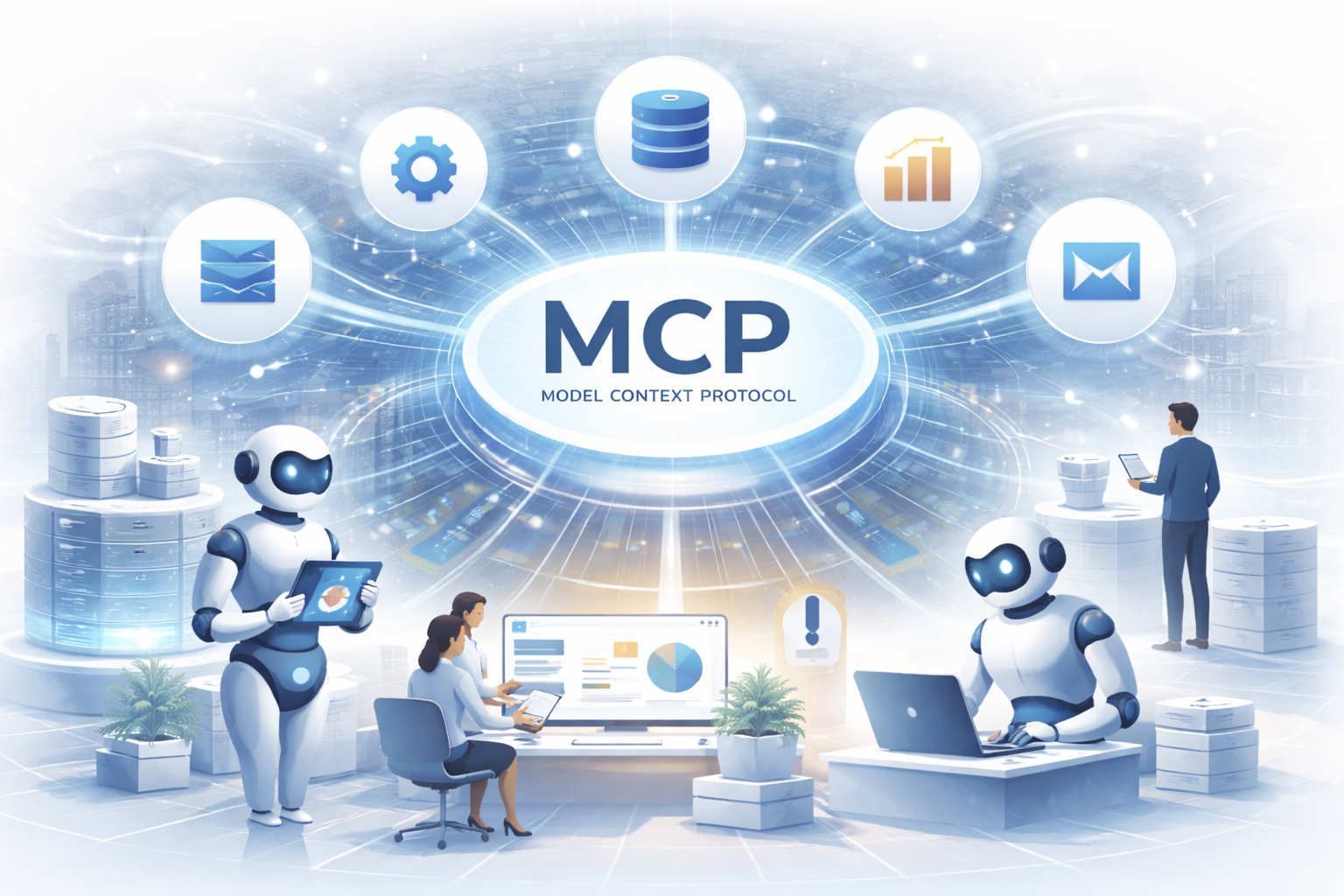
The Model Context Protocol (MCP) is an open standard that allows AI agents to securely connect to external tools, data sources, and enterprise systems. As agent-based architectures become more common, understanding what MCP actually does and when it is needed has become increasingly important for modern data and AI teams.
At first glance, MCP can look like just another integration layer. But in practice, it introduces a structured and governed way for AI systems to discover tools, request context, and execute actions safely. This shift is subtle but powerful, especially as organizations move from experimental copilots toward production-grade AI agents.
In this article, we break down what MCP is, how it works, where it fits in modern architectures, and when teams truly need it.
What Is the Model Context Protocol
The Model Context Protocol is an open specification that standardizes how AI models interact with external capabilities. Instead of allowing agents to directly call arbitrary APIs, MCP creates a consistent contract between the reasoning model and the tools it can use.
Through MCP, tools expose structured schemas that describe:
-
what the tool does
-
what inputs it expects
-
what outputs it returns
-
how it should be invoked
This allows AI agents to reason over available capabilities instead of relying on brittle, hard-coded integrations.
At a high level, MCP introduces predictability and governance into agent behavior.
Why MCP Matters for AI Agents
As AI systems become more capable, the primary risk is not intelligence. The real challenge is controlled execution.
Without a structured protocol, agents may:
-
call incorrect systems
-
produce inconsistent results
-
bypass governance controls
-
behave unpredictably across environments
MCP addresses these concerns by introducing a formal interaction loop between the model and external tools. Each tool call becomes intentional, observable, and schema-validated.
For enterprise environments, this is especially important because AI systems must respect:
-
security boundaries
-
semantic definitions
-
business logic
-
audit requirements
When implemented correctly, MCP helps move agent systems from experimental demos toward production-ready architectures.
How MCP Works in AI Systems
Understanding MCP becomes easier when you view it as a structured loop between the user, the reasoning model, and external tools.
Step 1: User Intent
The process begins when a user asks a question or triggers an action. The reasoning model interprets the request and determines whether external tools are required.
Step 2: Tool Discovery
The model evaluates the available MCP tool registry. Each tool exposes a structured schema describing its capability.
This is important because the model is not guessing tool names. It is reasoning over declared capabilities.
Step 3: Structured Tool Call
If a tool is needed, the model generates a structured MCP call that conforms to the tool schema. At this stage:
-
inputs are validated
-
permissions can be enforced
-
calls remain auditable
Step 4: Tool Execution
The MCP server executes the tool against the underlying system. This could involve querying a semantic model, retrieving governed data, or triggering a workflow.
Step 5: Response Grounding
The tool returns structured results to the model. The reasoning system incorporates this grounded information into the final response.
This closed loop is what makes MCP-based systems more reliable at scale.
MCP vs Traditional API Integrations
Many teams initially assume MCP is simply another API wrapper. The difference is deeper.
Traditional integrations are developer-driven. MCP interactions are model-mediated.
In traditional systems:
-
developers hard code integrations
-
logic lives in application code
-
observability is fragmented
In MCP-based systems:
-
tools are declarative
-
models reason over capabilities
-
execution is standardized
-
governance can be centralized
This shift enables more dynamic and scalable agent architectures.
When You Do and Do Not Need MCP
MCP is powerful, but it is not required for every AI workload.
You typically need MCP when:
-
agents must dynamically discover tools
-
multiple tools must be orchestrated
-
governance and auditability are critical
-
systems must scale across domains
You may not need MCP when:
-
workflows are fixed and deterministic
-
a single controlled data source is used
-
strong semantic grounding already exists
-
the platform tightly governs execution
For example, in environments where AI operates directly over a well-modeled semantic layer, some use cases can function effectively without introducing a full MCP layer.
Where MCP Fits in Modern Data Architectures
In modern enterprise stacks, MCP typically sits between the reasoning model and the execution layer.
A simplified mental model looks like this:
User → Reasoning Model → MCP Layer → Tools → Governed Data
In this architecture:
-
the reasoning model decides what to do
-
MCP enforces how it is done
-
tools execute against trusted systems
-
semantic models ensure metric consistency
When these layers are aligned, agent systems become significantly more predictable and enterprise-ready.
Common Mistakes Teams Make with MCP
As adoption grows, several patterns appear repeatedly:
- Treating MCP as an API wrapper. The value is the model reasoning over declared capabilities, not just a new way to call an endpoint. Wrap without the schema discipline and you lose the point.
- Skipping governance at the tool layer. MCP is where permissions and auditability should live. Bolting them on later reintroduces the risks MCP was meant to remove.
- Adding MCP where it is not needed. For a single, well-governed data source with strong semantic grounding, a full MCP layer can be overhead. Reach for it when reasoning and execution cross boundaries.
- Under-specifying tool schemas. Vague inputs and outputs make the model guess. Clear, strict schemas are what make tool calls predictable.
Closing Thought
MCP is not intelligence. It is discipline. It gives agents a structured, governed way to reach the tools and data they need, so the smarter the model gets, the safer its actions stay. Adopt it where reasoning and execution live in different systems, and keep it out of the places a well-governed semantic layer already covers.
Treating MCP as just another API wrapper
This misses the governance and discovery benefits.
Over introducing MCP in simple workflows
Not every use case needs dynamic orchestration.
Ignoring semantic grounding
Even with MCP, poor data modeling leads to unreliable answers.
Lack of observability around tool calls
The power of MCP comes from traceability. Without it, teams lose a major advantage.
Avoiding these pitfalls significantly improves early implementations.
Final Thoughts
The Model Context Protocol represents an important step toward more structured and governed AI systems. As organizations move beyond experimentation, the focus is shifting from raw model capability toward safe and reliable execution.
Understanding when MCP adds real value and when simpler patterns are sufficient is what separates experimental agent prototypes from resilient enterprise AI architectures.
🔍 FAQ Section
What is MCP in AI
MCP is an open protocol that allows AI agents to discover and call external tools in a structured and governed way.
Is MCP the same as an API
No. MCP is a standard protocol, while APIs are individual interfaces. MCP provides a consistent way for models to interact with many tools.
Do all AI systems need MCP
No. MCP is most useful when agents must dynamically orchestrate multiple tools under governance constraints.
How is MCP different from RAG
RAG focuses on retrieving documents for better answers, while MCP enables AI agents to execute actions through external tools.
Amrutha Satishkumar
Data & AI Solution Engineer at Microsoft